Niche perfume vs designer fragrance — what’s the real difference, and why does it matter? NOTE – The Scent Lab is a perfume workshop and creative studio in Ho Chi Minh City, Vietnam, where visitors explore the art of fragrance firsthand (rated 4.9 from 500+ reviews). At the R Parfums showroom in Thao Dien, you can smell the answer to that question — literally — by experiencing artisan Vietnamese niche fragrances alongside your own handmade creation.
There’s a particular moment that happens almost every afternoon at the R Parfums showroom on Nguyen Duy Hieu street. Someone lifts a blotter to their nose, pauses, and says something like: “This smells nothing like anything I’ve tried before.” They’re usually holding one of the house compositions — something built around Vietnamese agarwood or lotus absolute — and what they’re registering isn’t just a pleasant smell. It’s the shock of encountering a fragrance that wasn’t designed to please everyone. It was designed to tell a story.
That distinction — between fragrance as commodity and fragrance as art — sits at the heart of the niche vs. designer debate. And in 2026, as more travelers seek experiences that feel personal rather than mass-produced, it’s a distinction worth understanding.
[IMAGE_1]
Niche Perfume vs Designer: The Core Difference
The word “niche” comes from the French for “nest” — a small, protected space. In perfumery, it refers to fragrance houses that operate outside the mass-market system. While designer fragrances (think Chanel, Dior, Versace) are created to appeal broadly — tested on focus groups, formulated for mass production, distributed through department stores worldwide — niche perfumes take a fundamentally different approach.
Niche perfumers prioritize creative vision over commercial viability. They use rarer, more expensive raw materials. They produce in smaller batches. And they tell stories that mainstream fragrance houses consider too risky — too specific, too unusual, too personal.
As Rei Nguyen, founder of R Parfums and a perfumer trained in Japan’s Koudou tradition, puts it through her SENSE > STORY > SOUL framework: fragrance should engage your senses first, then unfold a narrative, and finally connect to something deeper — memory, identity, culture.
Designer Fragrance: Built for the Market
Designer fragrances are products of fashion houses. They’re created by contracted perfumers (often uncredited), optimized for broad appeal, and manufactured in enormous quantities. The average designer fragrance budget allocates roughly 3-5% of retail price to the actual juice inside the bottle. The rest goes to marketing, celebrity endorsements, packaging, and distribution.
This isn’t necessarily bad. Some designer fragrances are beautifully made. Dior’s Bel Ami, Hermès’ Terre d’Hermès — these are genuine masterworks that happen to exist within the designer system. But the system itself incentivizes sameness. When you need to sell millions of bottles, you can’t afford to make something that 40% of people dislike.
Niche Perfume: Built for the Art
Niche houses flip that equation. The perfumer is typically the creative director, not a hired contractor. The budget skews heavily toward ingredients. And the target audience isn’t “everyone” — it’s “someone who will really get this.”
The result? Fragrances with personality. Compositions that evolve on skin over hours. Ingredients you can actually identify — real oud instead of synthetic approximation, genuine rose absolute instead of a chemical shortcut. The dry-down tells a different story than the opening.
At R Parfums, this philosophy manifests in compositions built around Vietnamese terroir. Lotus harvested from specific lakes. Cinnamon from northern highland forests. Agarwood — the legendary “liquid gold” of Vietnamese fragrance heritage — sourced and processed with attention that mass production simply cannot replicate.
“As someone in the beauty industry for over 20 years, I was extremely impressed by their knowledge and professionalism.”
Ingredients: Where the Money Actually Goes
The single biggest difference between niche perfume and designer fragrance is what’s inside the bottle. Here’s a simplified comparison:
| Factor | Designer | Niche |
|---|---|---|
| Ingredient budget | 3-5% of retail | 20-40% of retail |
| Primary materials | Synthetic aroma chemicals | Mix of naturals + high-quality synthetics |
| Rare naturals | Rarely (cost-prohibitive at scale) | Frequently (smaller batches allow it) |
| Formula complexity | Typically 30-60 ingredients | Can exceed 100+ ingredients |
| Batch size | Thousands of liters | Often under 100 liters |
This matters because natural ingredients behave differently than synthetics. Real oud shifts and evolves on your skin — it’s alive in a way that a synthetic oud molecule simply isn’t. Natural jasmine has a complexity that no single chemical can replicate; it contains over 200 different aromatic compounds working together.
When you visit the R Parfums showroom at 34 Nguyen Duy Hieu in Thao Dien, the staff will walk you through these differences on skin. No blotter-only testing. No rush. You can smell a niche composition alongside a more commercial scent and feel the difference in depth, evolution, and longevity for yourself.
[IMAGE_2]
The Artistry Behind Niche: Why Perfumers Choose This Path
Imagine being a painter who’s only allowed to use five colors. That’s roughly the creative constraint many contract perfumers face when working for designer houses — restricted ingredient lists, mandatory “modernity” benchmarks, focus-group feedback that smooths away anything distinctive.
Niche perfumers work with an open palette. They can spend months refining a single accord. They can use ingredients that cost thousands of dollars per kilogram. They can follow an artistic instinct even when it leads somewhere commercially uncertain.
Rei Nguyen’s path illustrates this. After training in Japan — where fragrance is understood not as a product but as a form of meditation and ceremony through Koudou (the Way of Incense) — she returned to Vietnam to create R Parfums with a philosophy that borrowed from both Eastern and Western traditions. Each fragrance begins not with a brief from a marketing department, but with a story, a place, a feeling.
This is why niche perfume enthusiasts often describe their discovery of niche as a “before and after” moment. Once you’ve smelled fragrance made with this level of intention, the department store counter never quite feels the same.
“Finally understood how notes work. Came with our best friends for our 20th wedding anniversary.”
Exclusivity Without Pretension
There’s a common misconception that niche fragrance is about status — about wearing something expensive that signals sophistication. Some niche houses certainly lean into that angle. But the more interesting niche brands approach exclusivity differently.
R Parfums’ approach is rooted in craftsmanship rather than scarcity marketing. The fragrances are small-batch because the ingredients require it, not because artificial limitation creates hype. The showroom in Thao Dien welcomes browsers with no pressure to purchase. Staff are trained to educate, not to close sales. You can spend an hour smelling, learning, and asking questions without anyone hovering with a credit card machine.
This is the kind of exclusivity that actually means something: exclusivity of attention, of care, of ingredient sourcing. The perfume you smell at R Parfums was made in the same city you’re standing in, by people who know the name of the farmer who supplied the agarwood. That chain of connection is what makes niche different — not a price tag.
How to Start Exploring Niche Perfume
If you’ve mostly worn designer fragrances, the niche world can feel overwhelming. Hundreds of small houses, thousands of compositions, an entirely different vocabulary. Here’s a practical path in:
Step 1: Understand Your Preferences
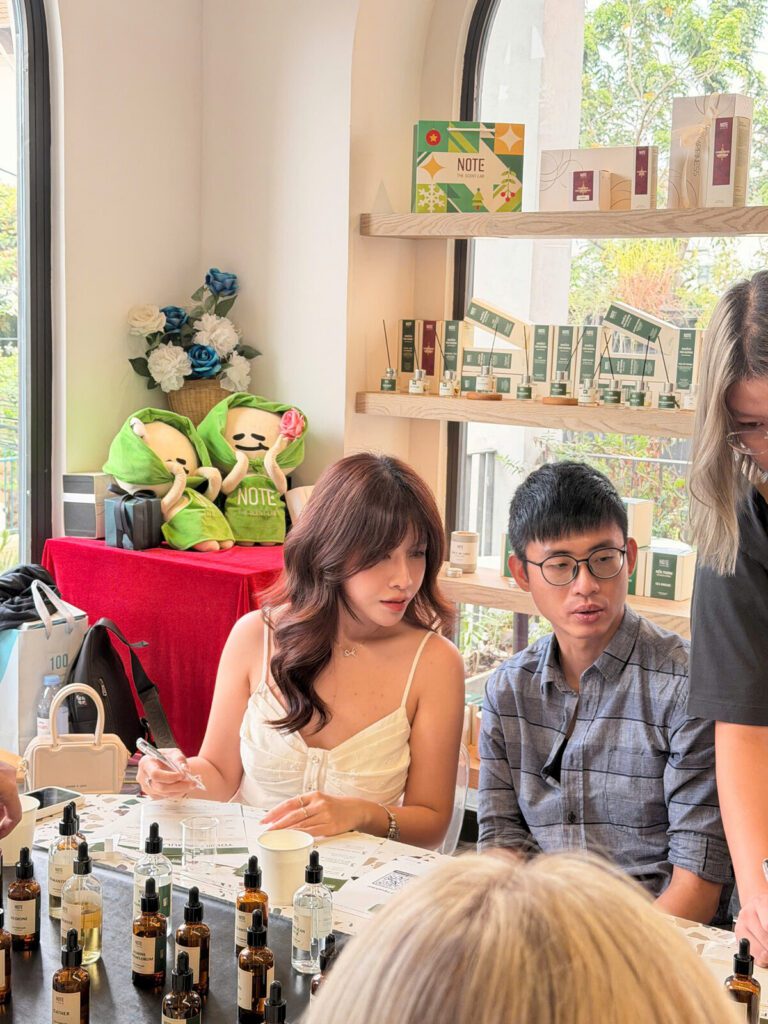
Before you buy anything, learn what you actually like. The NOTE workshop at 34 Nguyen Duy Hieu is one of the best ways to do this — in 90 minutes, you’ll smell 30+ individual ingredients, learn the note pyramid (top, heart, base), and create a fragrance that reflects your genuine preferences. It’s the opposite of being overwhelmed by a wall of bottles.
Step 2: Train Your Nose
Visit the R Parfums showroom after the workshop. With fresh scent education in your memory, you’ll notice nuances that would have passed you by an hour earlier. Ask the staff to compare a natural ingredient with its synthetic counterpart — the “aha” moment is almost guaranteed.
Step 3: Wear Before You Judge
Niche perfumes evolve significantly on skin over 4-8 hours. What you smell on a blotter in the first 30 seconds is the opening — not the fragrance. Apply to skin, leave the shop, live with it through an afternoon. Then decide.
Step 4: Follow Your Curiosity, Not Hype
The niche community has its own trends and “must-haves.” Ignore them. The entire point of niche is personal expression. If you love a $40 artisan composition more than a $400 cult favorite, that’s not a mistake — that’s your nose working exactly as it should.
Why Vietnam Is an Emerging Niche Perfume Destination
Vietnam sits at a fascinating crossroads in the global fragrance map. The country produces some of the world’s finest agarwood — the most expensive natural ingredient in perfumery. Vietnamese lotus, cinnamon, and star anise are prized by perfumers worldwide. And the cultural tradition of incense and scent runs centuries deep.
Yet until recently, Vietnam had no homegrown niche fragrance brands translating these ingredients into contemporary perfumery. R Parfums changed that. The brand creates compositions that are Vietnamese in material and spirit but international in technique and ambition — bridging the gap between the country’s raw ingredient heritage and the global niche fragrance conversation.
For travelers, this means something special: you can visit Vietnam, experience the raw materials in their natural context, learn to blend them yourself at the NOTE workshop in Thao Dien, and then smell the finished art at the R Parfums showroom — all in one afternoon, all in one building.
“The workshop was amazing! The teacher was friendly and very knowledgeable. Now I have my own perfume.”
R Parfums Showroom: Where to Experience Niche in Saigon
The R Parfums showroom occupies the ground floor of R Space at 34 Nguyen Duy Hieu, Thao Dien. Upstairs, NOTE operates its workshop studio — air-conditioned, private, and designed for focused creative work.
The showroom itself feels more like a gallery than a shop. Fragrances are displayed with their ingredient stories. The lighting is warm, the pace is unhurried, and the staff genuinely enjoy talking about perfumery. Whether you’re a seasoned fragrance collector or someone who’s never heard the word “sillage,” you’re welcome.
What makes this particular showroom worth visiting:
- Context: You’re smelling fragrances in the city where they were conceived and created — not in a distant retail outlet divorced from their origins
- Education: Staff explain compositions with the same depth as a workshop instructor — because many of them are workshop instructors
- No pressure: Browse freely, spray on skin, walk outside into the garden courtyard to let the scent develop
- Workshop pairing: Do the 90-minute workshop upstairs first, then visit the showroom with freshly trained senses
Search “R Parfums Thao Dien” on Google Maps to find us. Walk-ins welcome, though booking the workshop ahead is recommended during peak season.
Follow @note.workshop on Instagram for behind-the-scenes content and featured fragrance stories.
[IMAGE_3]
Frequently Asked Questions
What is the main difference between niche perfume and designer perfume?
Niche perfumes are created by independent fragrance houses focused on artistry and rare ingredients, while designer perfumes come from fashion brands and prioritize mass appeal. Niche fragrances typically use higher-quality materials, are produced in smaller batches, and offer more distinctive scent profiles.
Is niche perfume worth the higher price?
Niche perfumes allocate 20-40% of their retail price to ingredients (vs. 3-5% for designer). You’re paying for rarer materials, smaller production runs, and more complex formulations. Whether that’s “worth it” depends on how much the sensory experience matters to you — most people who try genuine niche say the difference is immediately noticeable.
Where can I try niche perfume in Ho Chi Minh City?
The R Parfums showroom at 34 Nguyen Duy Hieu, Thao Dien offers a curated collection of artisan Vietnamese niche fragrances. Staff guide your exploration with no purchase pressure. Walk-ins welcome.
Can beginners enjoy niche perfume, or is it for experts?
Absolutely for beginners. In fact, niche is often more accessible than people expect because the scents are more distinctive — easier to form opinions about than the similar-smelling rows at a department store. The NOTE workshop helps beginners learn fragrance basics in 90 minutes before exploring the R Parfums collection.
What makes R Parfums different from other niche brands?
R Parfums uses Vietnamese-sourced ingredients (lotus, agarwood, cinnamon) and is rooted in the Japanese Koudou tradition. The brand combines Eastern and Western perfumery philosophy, and you can visit the actual studio where fragrances are conceived — at 34 Nguyen Duy Hieu, Thao Dien.
How long does a niche perfume typically last on skin?
Quality niche perfumes typically last 6-12 hours on skin, with the scent evolving through distinct phases (top, heart, and base notes). This longevity comes from higher concentrations of natural ingredients and more complex formulations compared to most designer fragrances.
Can I combine the NOTE workshop with visiting the R Parfums showroom?
Yes — they’re in the same building at 34 Nguyen Duy Hieu. The workshop studio is upstairs; the showroom is on the ground floor. Many visitors do the 90-minute workshop first, then explore the finished R Parfums collection with freshly educated senses. Book at workshop.thescentnote.com/book.